Pain Relief Therapy Options in Kenya: Evidence-Based Solutions for Lasting Recovery
Understanding Pain and Its Impact in Kenya
Pain is more than a physical sensation. The International Association for the Study of Pain defines it as “an unpleasant sensory and emotional experience associated with, or resembling that associated with, actual or potential tissue damage.” This definition acknowledges that pain is subjective and shaped by psychological, emotional, and social factors.
The burden of pain in Kenya is substantial. A study in Nakuru County estimated the prevalence of acute pain at 51% (95% confidence interval 46–56). Chronic pain is even more widespread. In developing countries, prevalence ranges from 13% to 51%, while in sub-Saharan Africa a prevalence of 83% has been reported. In Kenya, the prevalence stands at an estimated 95%.
Low back pain is among the leading conditions contributing to functioning problems in Kenya, alongside major depressive disorder, HIV, and fractures. A scoping review found that back pain was the most prevalent functioning problem, affecting 78.1% of those studied, followed by unspecified pain at 56.3%. Among patients with low back pain at Mbagathi Sub-County Hospital, 55.7% reported moderate pain and 44.3% reported severe pain.
Arthritis is another significant contributor. A community-based study in Nyamira County found a prevalence of 44.6%, with knee arthritis being the most common type at 76.0%. Among participants with arthritis, 88.3% experienced activity limitation.
These figures reveal a clear truth: pain is not a rare or isolated problem in Kenya. It touches every sector of society—agricultural workers, office employees, healthcare professionals, and teachers alike.
Why Painkillers Alone Are Not the Answer
Pain medication plays an important role in acute pain management. However, relying solely on painkillers for chronic pain often fails to address the underlying causes.
As Tamara Dangerfield, a physical therapist at University of Utah Health, explains: “Opioids are only effective at treating pain for short periods of time. But with chronic pain, they become less and less effective and have large risks and side effects.” She adds: “Taking a pill may seem like a great option for people when they hurt and just want the pain to go away. But they can cause a lot of problems and actually make people more sensitive to pain over time.”
The limitations of painkillers are well documented. They provide temporary relief but do not correct movement dysfunction, muscle weakness, or joint instability. They do not address the fear-avoidance behaviours, pain catastrophising, or activity avoidance that often accompany chronic pain. Furthermore, long-term use of certain pain medications carries risks of dependency, tolerance, and adverse effects.
Physiotherapy: The Evidence-Based Foundation of Pain Relief
What the Research Shows
Physical therapy is “such an important part of treating chronic pain,” says Dangerfield. “The more we learn about it, the more we realize that movement is a critical part of retraining pain pathways.” With practice, movement-based therapies become more and more effective for pain control. The side effects of exercise include improved mood, blood pressure, weight control, bone density, endurance, strength, and sleep.
Pain relief through physical therapy is based on the understanding that pain is the brain’s interpretation of the signals it receives from all structures in the body. Those signals can be altered by the body’s own protective mechanisms. “Many people do not realize that the nerves and blood vessels travel through muscle and fascia tissue,” Dangerfield explains. “Poor movement of these tissues can influence pain and nerve signals anywhere in the body.”
Physical therapists work to restore the balance of coordination, flexibility, and strength so that movement, blood, and nerve flow are not hindered. Unlike other methods of reducing pain, physical therapy aims to improve pain control for the long run.
The Biopsychosocial Approach
Modern physiotherapy has shifted from a traditional biomedical model to a biopsychosocial approach. This model recognises that pain arises from bidirectional interactions between biological, psychological, and social factors. It views pain as a complex and subjective experience that cannot be reduced to tissue damage alone.
Physiotherapists working within this framework do not simply treat a diagnosis; they treat the whole person. They assess not only physical impairments but also psychological factors such as fear-avoidance beliefs, catastrophising, and self-efficacy. They address social factors that may influence recovery, such as work environment, family support, and access to resources.
Pain Relief Therapy Options Available in Kenya
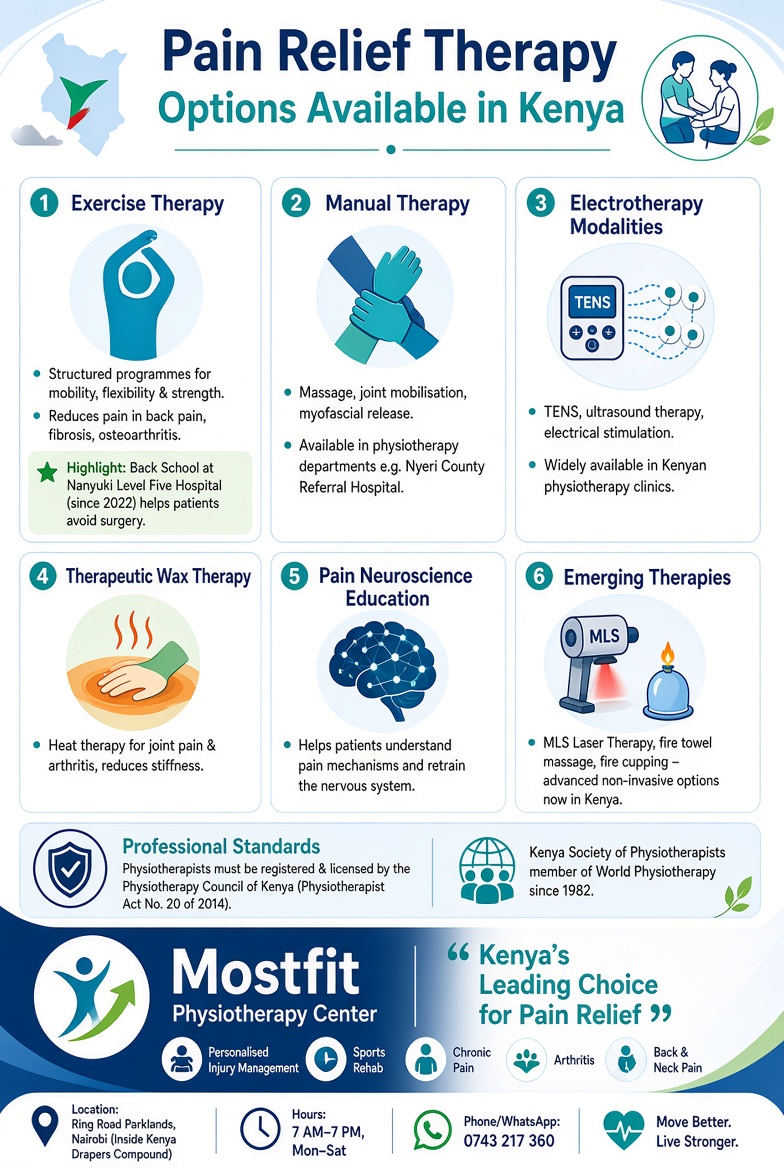
1. Exercise Therapy
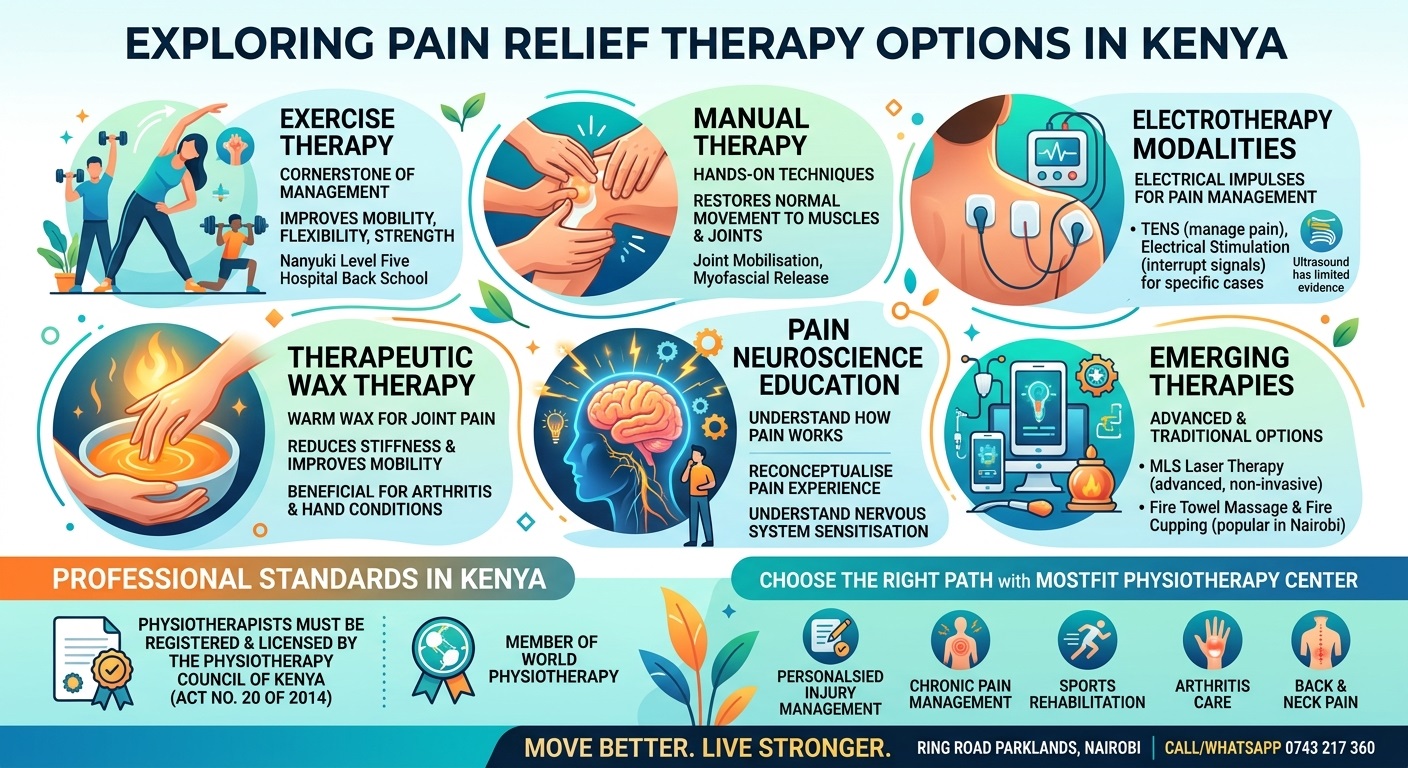
Exercise therapy is the cornerstone of physiotherapy-based pain management. It involves structured programmes designed to improve mobility, flexibility, and strength. High-quality evidence demonstrates that exercise therapy reduces pain and improves function for conditions including back pain, fibromyalgia, and osteoarthritis. These improvements are sustained for at least two to six months after treatment.
In Kenya, innovative exercise-based programmes are proving their worth. At Nanyuki Level Five Hospital, the Back School programme—founded in 2022—has helped hundreds of patients regain mobility, reduce painkiller dependence, and avoid surgery. Every Wednesday, about 50 patients ranging from 22 to 74 years old gather for two hours of vigorous exercises led by a physiotherapist.
The results speak for themselves. Florence Muthoni, 65, had been taking pain relievers for three years due to recurring back and leg pains. After eight sessions at Back School, surgery was no longer necessary. John Mithamo, who had been scheduled for orthopaedic surgery, saw his pain disappear after seven sessions. Consultant orthopaedic surgeon Samuel Ndanya confirms that “science has demonstrated that physiotherapy through vigorous physical activity leads to full recovery for cases that have not reached a critical stage.”
2. Manual Therapy
Manual therapy involves hands-on techniques including massage, joint mobilisation, and manipulation. These techniques restore normal movement to muscles, fascia, and joints, reducing pain and improving function. Myofascial release—the use of hands-on pressure to restore normal movement to muscle and fascia—is one such technique. Joint mobilisation—hands-on pressure to restore normal movement to joints—is another.
In Kenya, manual therapy is widely available in physiotherapy departments. Nyeri County Referral Hospital, for example, offers manual therapy as part of its comprehensive physiotherapy services.
3. Electrotherapy Modalities
Electrotherapy involves the use of electrical impulses to manage pain. Common modalities include:
- Transcutaneous Electrical Nerve Stimulation (TENS): A device used by physiotherapists to help manage pain by delivering electrical impulses through the skin to stimulate nerves.
- Ultrasound therapy: Uses sound waves to promote healing and reduce pain. However, research from a randomised controlled trial at Aga Khan University Hospital, Nairobi, found that the addition of ultrasound therapy to the treatment of acute low back pain did not improve patient outcomes as assessed by disability and pain scores.
- Electrical stimulation: The use of an electrical impulse to interrupt pain signals.
These modalities are available in physiotherapy departments across Kenya, including at Nyeri County Referral Hospital and other facilities.
4. Therapeutic Wax Therapy
Therapeutic wax therapy is used for joint pain relief and hand therapy. It involves the application of warm wax to affected joints, providing heat therapy that reduces stiffness and improves mobility. This therapy is particularly beneficial for patients with arthritis or hand conditions.
5. Pain Neuroscience Education
Pain neuroscience education helps patients understand how pain and the nervous system function, ultimately helping them reconceptualise their pain experience. When patients understand how pain works—how the nervous system can become sensitised, how thoughts and emotions influence pain perception, and how movement and activity can help retrain the brain—they are better equipped to engage in their recovery.
6. Emerging Therapies
Kenya is also seeing the introduction of advanced, non-invasive pain relief technologies. MLS (Multiwave Locked System) Laser Therapy has been introduced to Kenya, offering advanced, non-invasive and non-pharmacological treatment options for pain management, inflammation reduction, and enhanced healing.
Traditional therapies are also gaining traction. Fire towel massages, an ancient Egyptian technique, are becoming popular in Nairobi. Fire cupping therapy, which involves placing heated cups on the skin to create suction, is another ancient practice gaining traction in Kenya.
Professional Standards in Kenya
Physiotherapists practising in Kenya must be registered and licensed by the Physiotherapy Council of Kenya under the Physiotherapist Act No. 20 of 2014. The Kenya Society of Physiotherapists has been a member of World Physiotherapy since 1982, aligning local practice with international standards.
This regulatory framework ensures that patients receive care from qualified professionals who adhere to recognised standards of practice. When seeking pain relief therapy in Kenya, always verify that your physiotherapist is licensed and registered.
Pain Relief Therapy Options in Kenya: Choosing the Right Pain Relief Therapy
The best pain relief therapy depends on your specific condition, goals, and circumstances. Physiotherapy offers a range of options, which means patients who do not respond to one method may find relief in another.
At Mostfit Physiotherapy Center, we believe everyone deserves to receive the best service regardless of their age, skin colour, social status, or background. We are committed to offering world-class physiotherapy services to everyone who seeks our care. Our desire is to see people spend the shortest time recuperating, have fewer visits to the hospital, and as a result save money.
Our services include:
- Personalised injury management
- Tailored treatment programmes
- Healthy lifestyle consultation
- Sports injury rehabilitation
- Post-surgical recovery
- Chronic pain management
- Arthritis care
- Back and neck pain treatment
Physical therapy is a journey, not a destination. From the time we start your treatment to the time you get to full fitness, we are available to celebrate every milestone with you.
Why Mostfit Physiotherapy Center Is Kenya’s Leading Choice for Pain Relief
With so many physiotherapy providers in Nairobi, choosing the right clinic can feel overwhelming. We understand that. That is why we want to be transparent about what sets us apart and why patients consistently trust us with their recovery journey.
We Are Committed to World-Class Care for Everyone
We believe that everyone deserves to receive the best service regardless of their age, skin colour, social status, or background. This is not just a marketing statement; it is the foundation of everything we do. We are committed to offering world-class physiotherapy services to everyone who walks through our doors.
Our desire is simple: to see people spend the shortest time recuperating, have fewer visits to the hospital, and as a result save money. We know that pain and injury disrupt lives, careers, and families. Every day you spend in pain is a day you cannot fully live. That is why we focus on efficient, effective recovery that gets you back to what matters most.
Our Physiotherapists Are Among the Best in Kenya
We are proud of our team. Our physiotherapists are not just qualified; they are exceptional. Every physiotherapist practising in Kenya must be registered and licensed by the Physiotherapy Council of Kenya under the Physiotherapist Act No. 20 of 2014. This is the minimum standard. We go further.
Our practitioners bring together advanced clinical reasoning, hands-on expertise, and a genuine commitment to patient-centred care. They understand that pain is not just a physical signal but a complex experience shaped by biological, psychological, and social factors. They treat the whole person, not just the symptoms.
The Kenya Society of Physiotherapists has been a member of World Physiotherapy since 1982, aligning local practice with international standards. Our team operates at this level. We stay current with the latest evidence-based practices, ensuring that our patients benefit from the most effective treatments available anywhere in the world.
We Offer a Comprehensive Range of Evidence-Based Services
Pain relief is not one-size-fits-all. That is why we offer a diverse range of services designed to give you an all-round solution for your physical health needs. We tailor our services to each individual, whether you are an athlete recovering from a sports injury, a professional dealing with work-related strain, or someone managing chronic pain.
Our services include:
- Personalised injury management and tailored treatment programmes
- Sports injury rehabilitation
- Post-surgical recovery support
- Chronic pain management
- Arthritis care
- Back and neck pain treatment
- Healthy lifestyle consultation
Physical therapy is a journey, not a destination. From the time we start your treatment to the time you achieve full fitness, we are available to celebrate every milestone with you.
Our Location and Accessibility
We are conveniently located at Ring Road Parklands, Nairobi, inside the Kenya Drapers Compound. Our working hours are 7 AM to 7 PM, Monday to Saturday, making it easier for you to fit your appointments around your busy schedule.
We Walk With You Every Step of the Way
We value every engagement we get with every customer who chooses to let us become a part of their physical health journey. We are guided by values that make us who we are: integrity, compassion, and excellence.
When you choose Mostfit, you are not just choosing a clinic. You are choosing a partner who will stand with you from the first assessment to full recovery and beyond. We are always looking forward to seeing our clients attain full recovery and afterwards enjoy quality life.
Why This Matters for You
In a competitive market with top hospitals offering similar services, we believe our commitment to personalised, evidence-based, compassionate care makes the difference. We do not just treat pain; we treat people. We do not just manage symptoms; we address root causes. We do not just aim for recovery; we aim for lasting wellbeing.
Your health is your greatest asset. Entrust it to a team that truly cares.
Taking the Next Step
If you are living with pain, you do not have to accept it as your normal. Evidence-based pain relief therapy options are available in Kenya. The decision to seek physiotherapy is a decision to invest in your quality of life.
When you attend a physiotherapy consultation, you can expect:
- A thorough discussion of your medical history and current concerns
- Physical assessment of movement, strength, and function
- Clear explanation of findings and recommended treatment options
- A personalised treatment plan with realistic goals
- Practical advice for self-management between sessions
Don’t let pain control your life. Choose expert care. Choose lasting recovery. Choose a stronger tomorrow.
- 📍 Visit us at Ring Road Parklands, Nairobi (Inside Kenya Drapers Compound)
- 📞 Call or WhatsApp 0743 217 360 to book your consultation today
Move Better. Live Stronger.
References:
- Mostfit Physiotherapy Center. Our Services. Nairobi: Mostfit Physiotherapy Center. Available from: https://mostfitphysiocenter.com/our-services/
- University of Utah Health. Pain Relief Through Physical Therapy. Salt Lake City: University of Utah Health; January 2025. Available from: https://healthcare.utah.edu/healthfeed/2025/01/pain-relief-through-physical-therapy
- Strategies for improving the management of acute pain in households in Nakuru County, Kenya. KEMRI Repository. Available from: http://repository.kemri.go.ke:8080/xmlui/handle/123456789/1282
- Pain is an unpleasant sensory and emotional experience associated with actual and potential tissue damage. Meru University of Science and Technology. Available from: https://journals.must.ac.ke
- Impact of health conditions on daily functioning in Kenyan populations: A scoping review. PMC. 2025. Available from: https://pmc.ncbi.nlm.nih.gov/articles/PMC12067023/
- Arthritis Risk Factors among Adults in Tombe Location, Nyamira County, Kenya. Kenyatta University Repository. 2025. Available from: https://repository.ku.ac.ke
- Dancing away the pain: Inside Kenya’s unique back school where patients heal through rhythm. Nation Africa. Available from: https://nation.africa/kenya/health/dancing-away-the-pain-inside-kenya-s-unique-back-school-where-patients-heal-through-rhythm-5300602
- How Nanyuki hospital is using exercise to manage back pain. The Star. December 2025. Available from: https://www.the-star.co.ke/counties/central/2025-12-24-how-nanyuki-hospital-is-using-exercise-to-manage-back-pain
- Socio-Demographic Factors and Levels of Pain and Disability in Patients with Somatic and Neurogenic Low Back Pain at Mbagathi Sub-County Hospital. KEMRI Repository. 2024. Available from: https://repository.kemri.go.ke
- Physiotherapy Department. Nyeri County Referral Hospital. Available from: http://nyerireferralhospital.or.ke/department-details?id=31
- Physiotherapy Unit. Nsirh. Available from: https://www.nsirh.or.ke
- Cutting Edge Laser Technologies Partners with CheckUps Medical to Bring MLS® Laser Therapy to Kenya. Journal of Cyber Policy. November 2024. Available from: https://journalofcyberpolicy.com
- Healing heat: Kenyans warm up to fire therapy. Business Daily Africa. July 2025. Available from: https://www.businessdailyafrica.com
- World Physiotherapy. Kenya Society of Physiotherapists member profile. London: World Physiotherapy. Available from: https://world.physio/members/kenya
- Physiotherapy Council of Kenya. Registration and Licensing of Physiotherapists. Nairobi: PCK. Available from: https://pck.go.ke
This article is for informational purposes and does not constitute medical advice. Always consult a qualified physiotherapist for assessment and treatment of your specific condition.