How Your 8 Hour Desk Job Is Ruining Your Back and the Perfect Solution
Desk Job Back Pain? How Physiotherapy Fixes It
Introduction
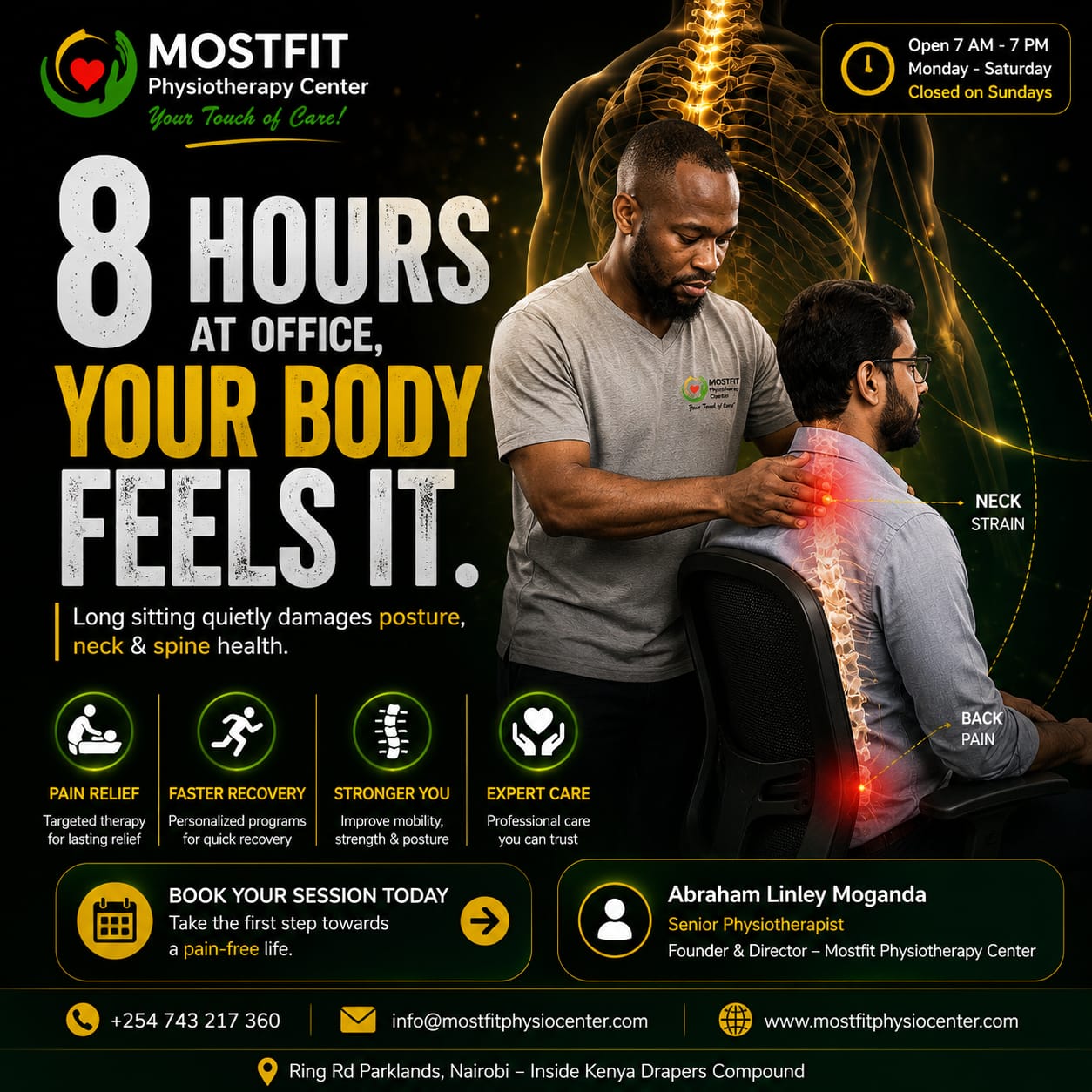
You don’t have to lift heavy weights to injure your back. Sometimes it is simply sitting 8 hours behind a desk at work. That stiff neck. That aching lower back. Those headaches after work. The shoulder tension that never seems to go away. They are not “just part of the job.” They are warning signs that your body needs attention.
Prolonged sitting is now recognised as the most common occupational safety risk in European workplaces, affecting 64% of workplaces. In Kenya, occupational sedentary behaviour stands at 78.4% among office and laboratory workers, and studies among bank personnel in Nairobi County have identified prolonged sitting and computer use as key risk factors for low back pain.
How Your 8 Hour Desk Job Is Ruining Your Back – What Happens to Your Back During 8 Hours of Sitting
 When you sit for extended periods, your body undergoes several biomechanical changes. Compared to standing, sitting decreases lumbar lordosis, increases low back muscle activity, disc pressure, and pressure on the ischium. These changes are directly associated with occupational low back pain.
Sedentary office workers often adopt prolonged sitting postures that disrupt the lumbar-pelvic rhythm – the coordinated movement between your lower spine and hips. A 2025 study found that office workers with low back pain showed significantly different lumbar flexion patterns during trunk movement compared to pain-free colleagues. The research identified hip flexion muscle strength as a contributing factor to this altered movement pattern.
Prolonged static sitting also contributes to:
- Tightening of lower extremity musculature
- Decreased circulation to spinal structures
- Physical deconditioning
- Poor postural habits that persist even when standing
The Numbers Are Clear: This Is a Widespread Problem
Research consistently demonstrates the scale of this issue. A 2025 study of office workers in Kraków found that 92.6% reported experiencing lower back pain, with 65.4% suffering from chronic conditions for several years. Among academic staff in Ethiopia, the seven-day prevalence of low back pain was 44.8%, rising to 55.68% over twelve months.
Working more than 8 hours per day was statistically associated with low back pain, alongside physical inactivity. A study in Peshawar found that 88% of office workers reported musculoskeletal discomfort, with the lower back being the most common site at 64%. Prolonged sitting duration was significantly associated with discomfort in the cervical spine, elbows, and wrists.
Office workers frequently report low back pain and neck pain related to sedentary work. The prevalence rates range from 31% to 51% for low back pain and 42% to 69% for neck pain among office workers globally. In some studies, prevalence among office workers has been reported as high as 64%.
The World Health Organization reports that approximately 1.7 billion people globally live with musculoskeletal conditions, including low back pain and neck pain. These conditions are leading causes of work absence and early retirement, creating enormous impacts through increased healthcare costs, workforce shortages, and lost productivity.
Why Quick Fixes Fail
Many people turn to painkillers or rest when back pain strikes. These approaches mask symptoms rather than resolve them. Painkillers suppress the signal. Rest reduces immediate discomfort. But neither addresses the underlying cause.
The WHO recommends non-surgical interventions for chronic low back pain, including exercise programmes and physical therapies such as spinal manipulative therapy and massage. Physiotherapy is explicitly recommended to improve muscle strength and mobility and to support the resumption of physical activity and exercise.
Research confirms that interventions targeting lumbar motor control – the ability to coordinate and control movement of the lower spine – are effective in improving motor control in the lumbar region and hip joints, thereby ameliorating low back pain in sedentary office workers.
How Your 8 Hour Desk Job Is Ruining Your Back and the Perfect Solution
The Physiotherapy Solution: Treating the Root Cause
 Professional physiotherapy offers a structured, evidence-based approach to recovery. Rather than masking symptoms, physiotherapy addresses the mechanical, muscular, and postural factors that cause pain.
- Comprehensive Assessment
Your first visit includes a detailed evaluation. We assess your medical history, movement patterns, strength, flexibility, and functional limitations. This assessment identifies the root cause of your pain – not just the symptoms. - Personalised Treatment Plan
We create a treatment plan tailored to your specific condition, goals, and lifestyle. Research shows that individualised plans reduce the risk of recurrence and increase the chances of stable long-term recovery. - Evidence-Based Interventions
We use interventions supported by clinical research, including:
- Exercise therapy.Dynamic motor control exercise for the lumbar region is effective in improving motor control and reducing low back pain in sedentary office workers. Strengthening exercises enhance long-term spinal stability.
- Manual therapy.Hands-on techniques relieve muscle tension, improve joint mobility, and promote relaxation.
- Postural and ergonomic education.Training in proper sitting posture, workstation alignment, and neutral spine position helps reduce lumbar strain during daily office activities.
- Active break strategies.Research shows that active breaks – short periods of movement during the workday – effectively reduce spinal pain and presenteeism. Even simple measures, such as taking regular standing breaks to reduce prolonged sitting, can make a significant difference.
- Ongoing Support
Recovery is not linear. We track your progress, adjust your programme as needed, and provide the support you need to stay on track.
Prevention: Protecting Your Back at Work
 Prevention is always better than cure. The CDC recommends addressing workplace factors that contribute to low back pain as part of a workplace prevention strategy. Here is what you can do:
- Adjust your workstation.Your chair should support your spine’s natural curvature. Seat height should allow your feet to rest flat on the floor with your thighs approximately parallel to the floor. Your monitor should be at eye level and about an arm’s length away.
- Move regularly.Therapists advise changing positions every 30 minutes to one hour. The evidence supports alternating between sitting and standing every 30 to 60 minutes.
- Stay active outside work.Physical inactivity is a significant risk factor for low back pain. Regular exercise outside working hours helps maintain the strength and flexibility needed to withstand prolonged sitting.
- Seek professional help early.Do not wait until the pain becomes unbearable. Early intervention prevents conditions from becoming chronic and more difficult to treat.
How Your 8 Hour Desk Job Is Ruining Your Back and the Perfect Solution – Why Choose Mostfit Physiotherapy Center in Nairobi
The physiotherapy market in Nairobi is competitive, with top hospitals and clinics offering similar services. What sets Mostfit apart is our commitment to personalised, evidence-based care delivered by experienced professionals.
- Expert Leadership: Our founder, Abraham Linley Moganda, brings years of clinical experience and a deep understanding of musculoskeletal health.
- Patient-Centred Approach: We treat you as an individual, not a diagnosis. Your goals and preferences guide your treatment.
- Evidence-Based Practice: We base our interventions on the best available research and clinical guidelines, including those from the World Health Organization.
- Convenient Location: We are located in Westlands, Nairobi, inside Kenya Drapers Compound on Ring Road Parklands.
- Comprehensive Services: From back pain to sports injuries to post-surgery rehabilitation, we cover the full spectrum of physiotherapy needs.
Frequently Asked Questions
- How does sitting for 8 hours a day cause back pain?
Prolonged sitting decreases lumbar lordosis, increases disc pressure, and disrupts the lumbar-pelvic rhythm. These biomechanical changes, combined with muscle tightness and deconditioning, contribute to low back pain. - Can physiotherapy help with chronic back pain from desk work?
The WHO recommends physiotherapy as a non-surgical intervention for chronic low back pain. Research shows that exercise therapy and motor control interventions are effective in reducing pain and improving function in sedentary office workers. - How long does physiotherapy take to work?
The timeline varies depending on your condition, its severity, and your adherence to the treatment plan. Many patients notice improvement within a few sessions. Chronic conditions may require several weeks of consistent treatment. - Do I need a doctor’s referral?
In most cases, you can book a physiotherapy appointment without a referral. However, we recommend checking with your insurance provider regarding coverage requirements. - Can physiotherapy prevent future back problems?
Physiotherapy addresses muscle imbalances, movement dysfunctions, and postural habits that predispose you to injury. Many patients continue with maintenance programmes to prevent recurrence.
Take the First Step Toward Lasting Recovery
 You do not have to live with back pain. You do not have to rely on temporary fixes that leave you vulnerable to recurrence. Professional physiotherapy offers a path to lasting recovery – one that addresses the root cause of your pain and builds the strength and confidence you need to move freely.
Your body has carried you every single day. It is time to take care of it.
We understand that choosing a physiotherapy provider in Nairobi can feel overwhelming. With so many options available, how do you know who to trust? Look for evidence-based practice, personalised care, and a team that listens to you. That is what we offer at Mostfit Physiotherapy Center.
Book your consultation today. Let us help you move better, live stronger, and enjoy life without pain.
Contact Mostfit Physiotherapy Center
- 📍 Ring Road Parklands, inside Kenya Drapers Compound, Nairobi (100 metres from The Oval)
- 📞 +254 743 217 360
- 📧info@mostfitphysiocenter.com
- 🕐 Monday–Saturday, 7 AM – 7 PM
References:
- Finnish Institute of Occupational Health
In Finland, time pressure is perceived as the second most common occupational safety risk — prolonged sitting still ranks first in Europe
TTL
Accessed 8 September 2026
https://www.ttl.fi/en/topical/press-release/in-finland-time-pressure-is-perceived-as-the-second-most-common-occupational-safety-risk-prolonged - Mutua MM, Waiganjo L, Boit E
Low Back Pain and the Severity amongst Bank Personnel within Nairobi City County
International Journal of Physiology, Health and Physical Education, 2024;6(1):14-19
Accessed 8 September 2026
https://repository.ku.ac.ke/items/2203c362-bb23-4723-9982-eb5fec65ba6f/full - Centers for Disease Control and Prevention
Low Back Pain among Workers: The Problem and What to Do About It
CDC
Accessed 8 September 2026
https://www.cdc.gov - Differences in Lumbar–Pelvic Rhythm Between Sedentary Office Workers with and Without Low Back Pain: A Cross-Sectional Study
Healthcare, 2025;13(10):1135
Accessed 8 September 2026
https://pmc.ncbi.nlm.nih.gov/articles/PMC12111153/ - Kupczak W, Piotrowska A, Zawiliński J, et al.
The impact of sedentary office work on lumbar spine load
Med Og Nauk Zdr, 2025;31(1):49-54
Accessed 8 September 2026
https://www.monz.pl/pdf-199542-123764 - Low back pain among academic staff at a university in Ethiopia: a cross-sectional study
BMJ Open, 2025;15(10):e096965
Accessed 8 September 2026
https://opus.lib.uts.edu.au/handle/10453/190623 - The association of prolonged sitting with musculoskeletal discomfort among office workers of Peshawar, Pakistan: A Cross-sectional study
Advances in Allied Health Sciences, 2025
Accessed 8 September 2026
https://aahs.kmu.edu.pk - Developing and validating prediction models for low back pain and neck pain in office workers: a cross-sectional study
Scientific Reports, 2026;16:980
Accessed 8 September 2026
https://link.springer.com/article/10.1038/s41598-025-30575-4 - Molina Aragones JM, et al.
Estudio transversal. Dolor lumbar y medidas ergonómicas en puestos de trabajo en oficinas
Revista de la Asociación Española de Especialistas en Medicina del Trabajo, 2024;32(4):323-329
Accessed 8 September 2026
https://scielo.isciii.es/scielo.php?script=sci_abstract&pid=S3020-11602023000400006 - World Health Organization
WHO guideline for non-surgical management of chronic primary low back pain in adults in primary and community care settings
WHO
Accessed 8 September 2026
https://www.who.int - Effect of Interventions for Improving Lumbar Motor Control on Low Back Pain in Sedentary Office Workers: A Randomized Controlled Trial
Physical Therapy Research, 2021;24(3):240-248
Accessed 8 September 2026
https://pubmed.ncbi.nlm.nih.gov - Prevalence of Sedentary Lifestyle among Workers in Kenya Agricultural and Livestock Research Organisation’s Institutes in Nairobi Metropolitan
JKUAT
Accessed 8 September 2026
https://ir.jkuat.ac.ke